Not a Kickstarter user? Leave your email and we will send one note the day it goes live, plus Local Spots news. No spam, unsubscribe any time.
You're on the list.
How to Play
Objective
Be the first player to build a $40M portfolio. Your portfolio
grows by building locations, by filling a whole neighbourhood, and by
reaching the goals on your Developer Agenda.
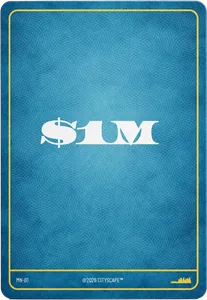
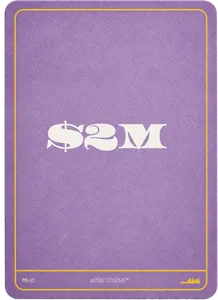
Local Business$1MCulture$2MPark$2MLandmark$3M
Develop a neighbourhoodBuild every slot, Landmark included.+$5M each
Every player is dealt one Money card and one City card, then five
locations come up for bidding. The highest bid wins and pays right
away.
T
TURNS
Every player takes one full turn: build, play an event, collect
revenue, or use the Property Market.
E
END
Portfolio value is counted, hands are trimmed to seven cards, and the first player to $40M wins.
Good to know. Tied bids are settled by
one more round of bidding, then a die roll. Up to twice per auction, on the
first lot only, you may burn a City Event, Special Event, Appeal, or
Revenue Collection card to gain a Money card.
Money cards are spent whole and no change is given, so
anything you overpay goes to the bank. The one exception is the $5M rule:
overpay using a $5M bill and you draw a single Money card back. It is drawn
blind, so it may be worth more or less than you overpaid.
Your Turn
1
ACT
Build a location, play a City Event, collect revenue, or list a card
on the Property Market.
2
END
If you are holding more than seven cards, discard down to seven.
Building
Building is free. It costs one action and nothing else.
Take a location from your hand and build it into the neighbourhood it
belongs to. Fill every slot, Landmark included, to develop
that neighbourhood and add +$5M. Once developed, nothing built there can
be stolen.
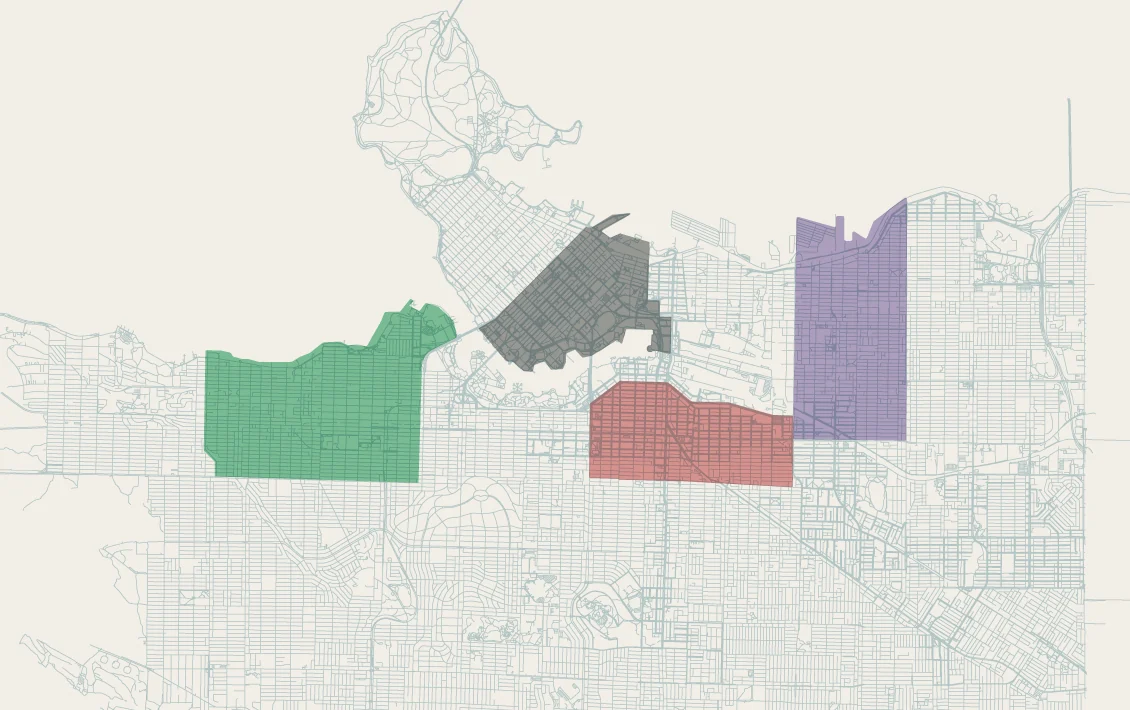
Neighbourhood Slots
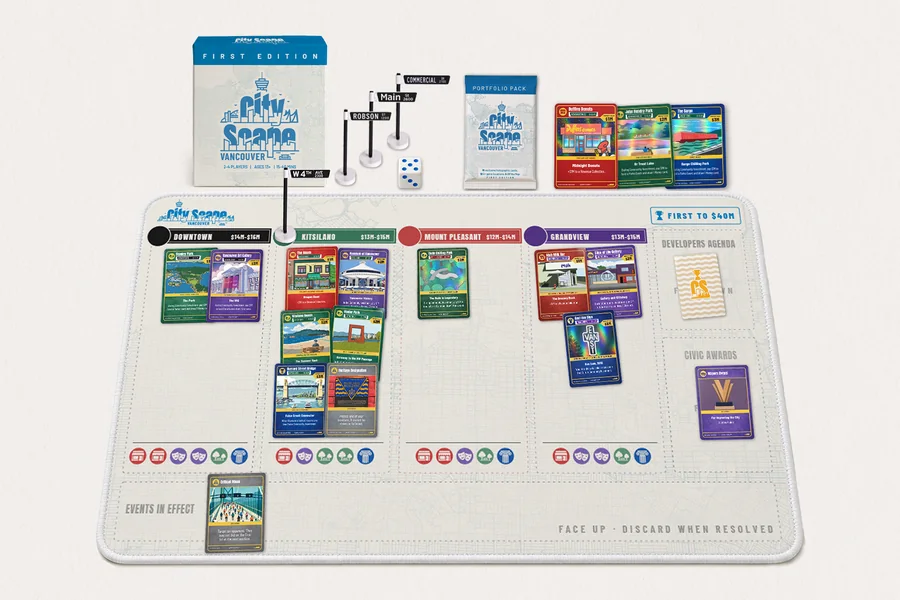
Numbers = what each slot adds to your portfolio. Build them up, then add a Landmark to develop the neighbourhood.
Downtown ★ DEVELOPED · +$5M
BIZ+$1MBIZ+$1MCUL+$2MCUL+$2MPARK+$2MLMK+$3M
Grandview/Woodland
BIZ+$1MCUL+$2MCUL+$2MPARK+$2MLMK+$3M
Kitsilano
BIZ+$1MCUL+$2MPARK+$2MPARK+$2MPARK+$2MLMK+$3M
Mt Pleasant
BIZ+$1MBIZ+$1MCUL+$2MPARK+$2MLMK+$3M
Every neighbourhood has a Landmark slot.
Building the Landmark completes the neighbourhood and switches on its own
special ability.
City Events
The City deck is 42 cards, and most of them are events. Every
player is dealt one City card each round, and once a turn you may buy one blind
from the deck for $2M. Playing a City Event or a Special Event
costs one of your four actions. Pandemic and Community
Investment are the two that must be played as your first action.
Nothing in the deck takes a turn away from you: the harshest of them cut you to
two actions or stop you building for a round, but you always get to play.
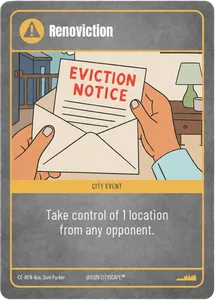
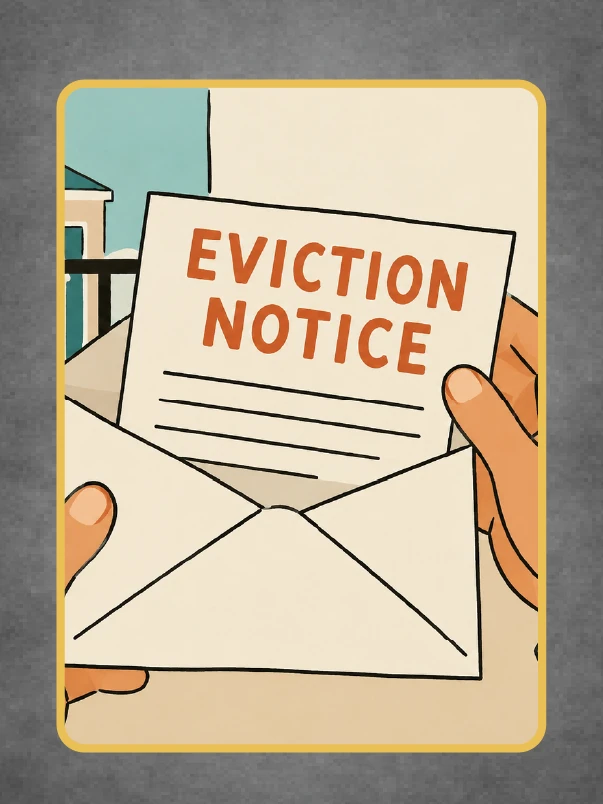
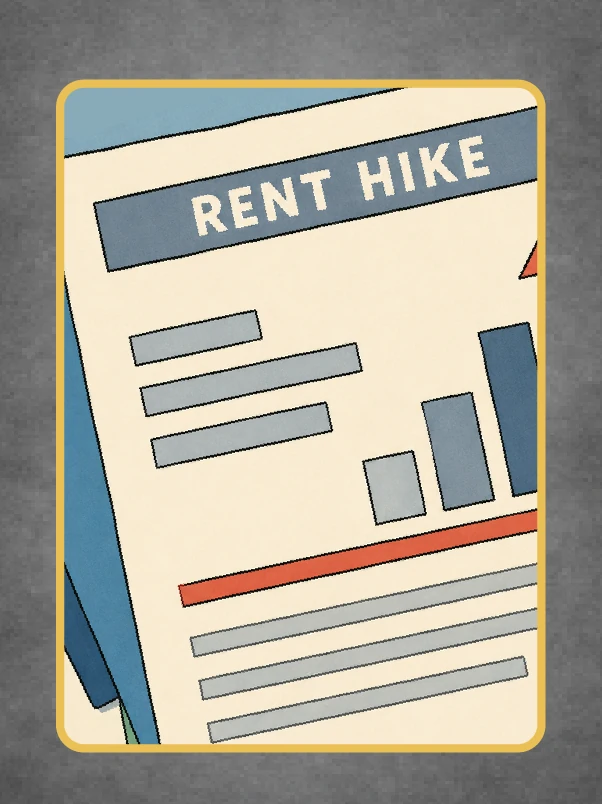
What they do. Renoviction steals a Local Business
or Culture location outright. Rent Hike makes one player pay $2M or forfeit a
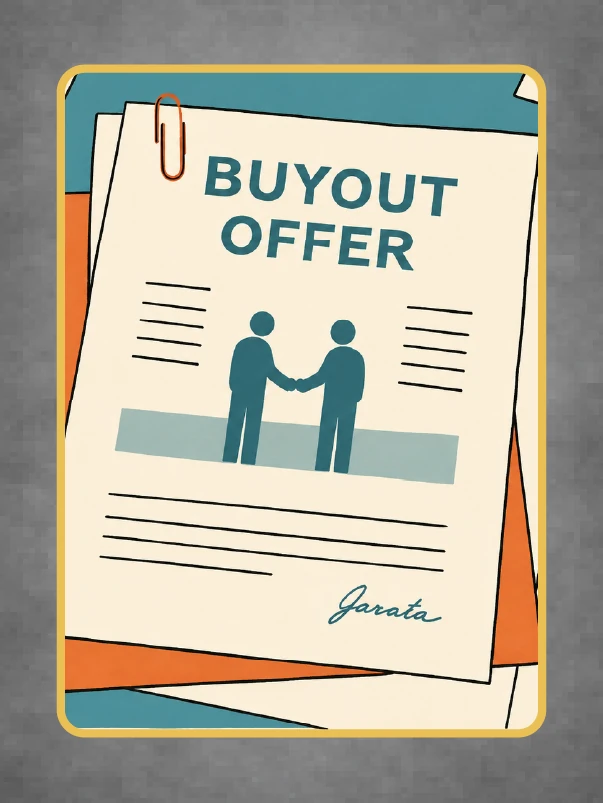
Business or Culture location. Buyout pays a location's property value to take it.
Market Crash makes everyone discard half their money, rounded down.
Appeals
Appeals are your defence, and they are free. Playing one costs no
action and no money. An appeal window only opens for an offensive
City Event, and an appeal protects only you, so a card that hits
the whole table still resolves for everybody else. Special Events can never be
appealed. Revenue Collection is answered only by Payment Deferred, which is also
free.
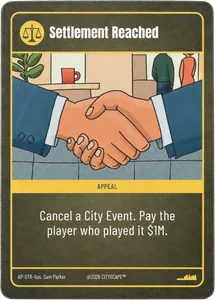
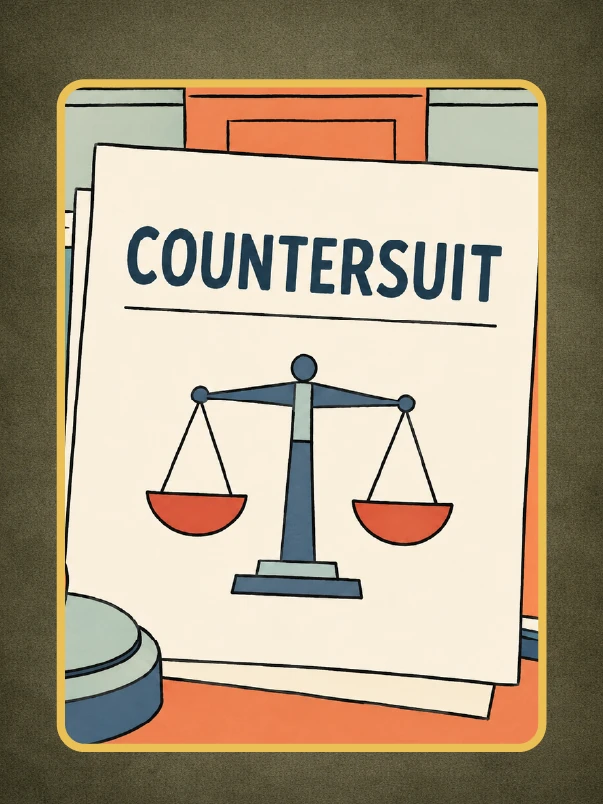
Countersuit
Cancels a City Event aimed at you and reverses it, so the
effect lands on the player who played it.
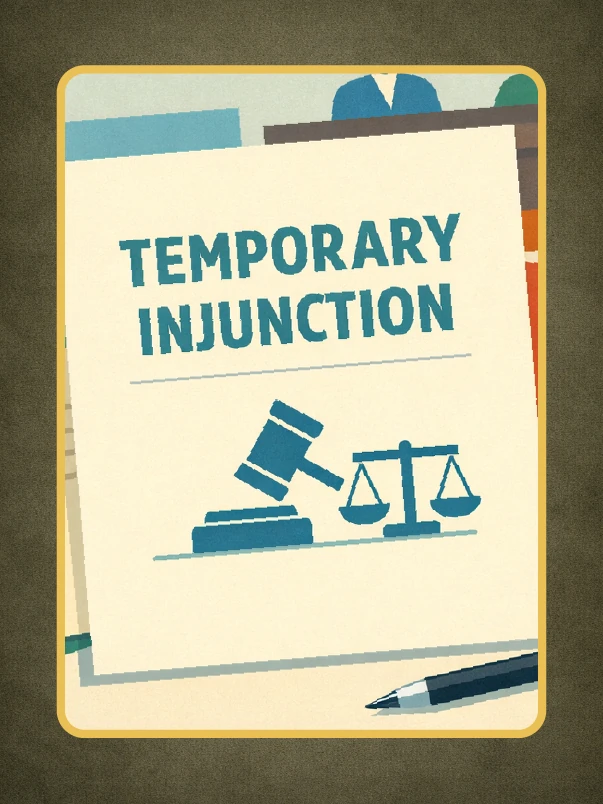
Temporary Injunction
Blocks a City Event aimed at you. The card is spent and the event simply
does not happen to you.
Two more ways out. Build the Vancouver
City Hall landmark and it shields you automatically from the next city
event aimed at you. And any card from this deck can be burned for a Money card
during an auction, as described in The Basics. Revenue Collection and Community
Investment come from this deck too, and they have their own tab,
Money.
Developer Agendas
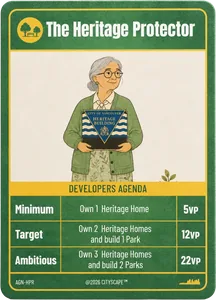
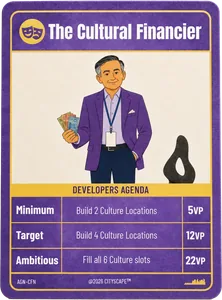
In the first round every player is dealt two Developer Agenda
cards, face up to you and hidden from everyone else. Keep one and discard the
other. You can decide at any time, but you must decide by the
end of Round 3, and the choice is permanent. Each agenda sets
three goals of rising difficulty. You score the value of the highest goal you
have reached, so a bigger goal replaces the smaller score rather than adding
to it.
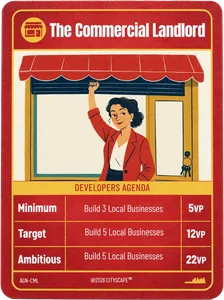
The Developer
MINFill all base slots in 1 neighbourhood$5M
TARGETFully develop 1 neighbourhood$12M
AMBITIOUSFully develop 2 neighbourhoods$22M
Revenue Collection and Community Investment
Two different cards turn your built locations into money, and they do not
do the same thing. Revenue Collection collects what your rivals have spent
at your businesses. Community Investment draws you a free card, then lets every
player, you first, spend their own money to fund the arts or donate to a park.
Revenue Collection
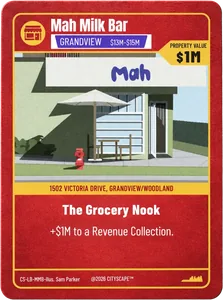
Your rivals have been shopping at your businesses. Every opponent pays you $1M for each Local Business you own, up to $4M each. Anyone who cannot pay must forfeit one of their locations instead.
Community Investment
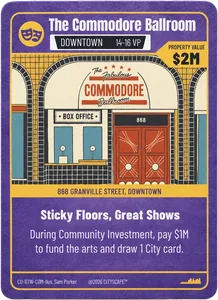
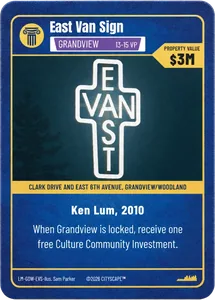
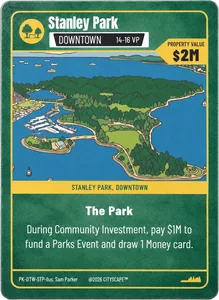
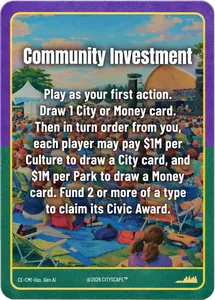
Play it as your first action and draw 1 card of your choice. Then every player, you first and then turn order, may fund. Fund the Arts: pay $1M per built Culture location to draw that many City cards. Park Donation: pay $1M per built Park to draw that many Money cards. Fund as many or as few as you like.
Civic Awards. Fund two or more Parks in a
single Community Investment to claim a Park award, or two or more Culture
locations to claim a Culture award. Each award is worth $3M
and can never be taken from you. Wildcards do not count toward it, and the
pool is limited, so once the awards run out there is nothing left to claim.
Property Market
L
LIST
List a location from your hand and draw one Money card.
B
BUY
Buy a listed location from the market for its property value.
C
CITY
Buy a card from the City Deck for $2M, once a turn.
Wildcards
Three cards fit wherever you need them. Each adds
$1M to your portfolio when built, even in a slot where a
regular card would add $2M, and each has a property value of
$1M, which is what a rival pays to buy one out and what you
get back for selling it.
Food Truck
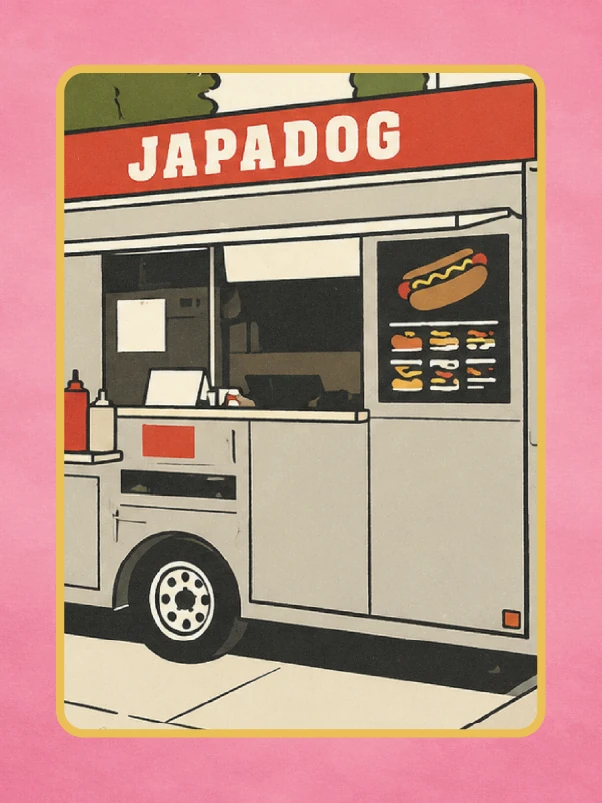
Fills any open Local Business slot in any neighbourhood. It counts for Revenue Collection and can move for $1M once a turn.
Public Art
Fills any open Culture slot in any neighbourhood, but it does not qualify for Community Investment funding.
Heritage Home
Fills any open Park slot in any neighbourhood, but it does not qualify for Community Investment funding.
🔰Round 1 is the grace round. Everyone
bids and takes a normal turn, but City Events and Revenue Collection are
blocked, so nobody can attack you while you are finding your feet. You have
until the end of Round 3 to commit to a Developer Agenda.
Achievements
Earned on this device, and kept for good. Locked ones show what to aim for.
Hall of Fame
The best scores players have posted. Finish a game and you can add yours.
Tips & Reminders
Everything the game has told you, or is about to. Nothing here is ever hidden.